
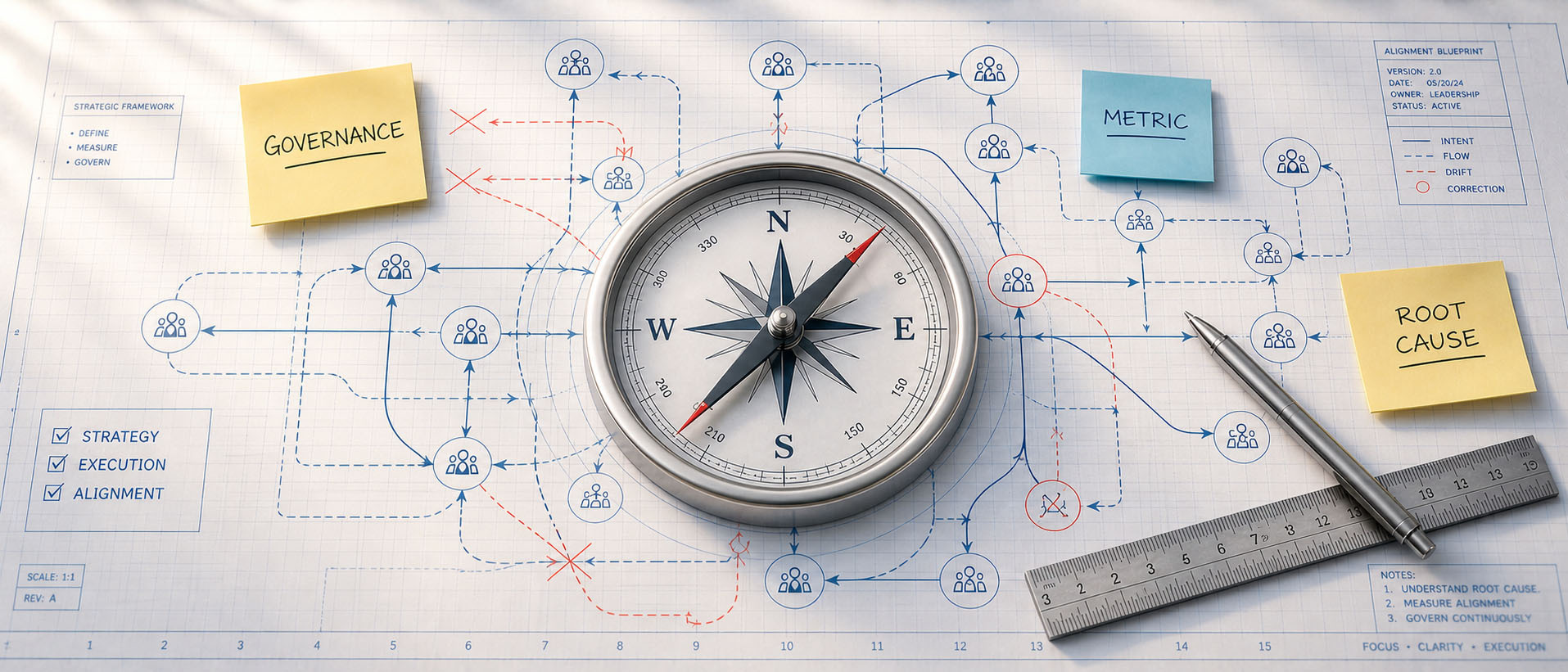
What It Means to Govern Alignment. Not Just Measure It
Most organizations are not failing at alignment because they lack commitment. They are failing because they have never understood the root cause, never had a metric to track it, and never built the structure to sustain it. Those are three distinct problems. And solving only one of them is not enough.
When execution breaks down, when initiatives stall, when departments drift, leadership feels it. The friction is real. The costs are real. But the cause is rarely identified with precision. Most leaders attribute the symptoms to communication gaps, personnel issues, or strategic complexity. They address those things. And the friction returns.
What they are missing is a diagnosis. Not a general sense that something is off, but a clear, data-backed understanding of where organizational alignment has broken down and why. Without that diagnosis, every response is a guess. And guesses do not solve structural problems.
The organizations that move past this cycle share three things: they understand what misalignment actually is, they have a metric to measure it, and they have a governance system to manage it over time. Most organizations have none of the three.
Problem One: Not Understanding the Root Cause
The word misalignment gets used loosely in most organizations. It describes everything from a difficult cross-functional relationship to a failed product launch to a team that seems disengaged. Used that broadly, it explains nothing and points to nothing actionable.
Misalignment has a specific root cause. It is the gap between what leadership believes it has communicated and what the organization actually understands. Not how employees feel about the company. Not whether they are engaged or satisfied. Whether they comprehend the strategy the same way leadership does — and whether they are making decisions that reflect that comprehension.
That gap forms quietly. It does not announce itself in a single event. It accumulates as strategy travels through layers of management, through departments with different operational realities, through new hires who inherit whatever version of the strategy already exists in their corner of the organization. By the time the gap is visible in results, it has been compounding for months.
Most leaders never name it this precisely. They feel the symptoms — the friction, the rework, the repeated conversations that never seem to land — without identifying the structural source. And because the source is not identified, the responses address the surface without touching the root.
Problem Two: No Metric to Track It
What gets measured can get improved. What does not get measured does not get improved. It gets assumed.
Organizational alignment is almost universally assumed. Leadership communicates strategy, runs planning cycles, holds all-hands meetings, and operates under the belief that the organization understands the direction. That belief is rarely tested. There is no score. There is no baseline. There is no way to know whether alignment is improving or deteriorating — until it shows up in financial results, by which point the cost is already significant.
This is the operational blind spot that sits upstream of revenue, EBITDA, retention, and every other metric leadership tracks. Those metrics measure outcomes. Alignment measures the condition that produces them. And the condition is going unmeasured in most organizations.
Without a metric, there is no visibility. Without visibility, there is no early warning. Without early warning, leadership can only react — after the drift has already become drag, after the initiatives have already stalled, after the quarter has already been lost.
Problem Three: No System to Sustain It
Even organizations that do measure alignment face a third problem: they measure once and move on. The assessment reveals gaps. Leadership responds. The gaps narrow. And then, gradually, the drift returns — because nothing structural changed in how the organization maintains shared understanding over time.
Alignment is not a condition that gets corrected once and holds. Organizations grow. They hire. They launch new strategies, enter new markets, and restructure teams. Each of these events is an alignment event — a moment where the gap between leadership intent and organizational comprehension can widen. Without a governance system, every one of these events is a potential source of drift that goes undetected until it surfaces in performance.
A governance system means alignment is tracked on a consistent basis, not assessed once. It means leadership has a decision standard that prevents drift from re-forming as the organization evolves. It means the score is reviewed alongside financial results — not treated as a separate initiative — because it is the upstream condition those results depend on.
Measurement without governance is a snapshot. Governance turns that snapshot into a continuous view — the difference between knowing where you were and knowing where you are going.
Why All Three Problems Must Be Solved Together
Understanding misalignment without measuring it leaves leadership with language but no data. Measuring it without a governance system produces a score that fades in relevance as the organization moves on. And attempting to govern something that has never been clearly defined produces structure around the wrong problem.
The three problems are connected. Solving them requires a system that addresses all three in sequence: define the root cause clearly, establish a metric to track it, and build the governance structure to sustain improvement over time.
Organizations that do this do not just fix alignment. They build an execution advantage that compounds. They spend less leadership capacity managing symptoms. They deploy resources against a strategy they can verify the organization understands. And they catch drift early — at Stage 2 or Stage 3, before it becomes the Stage 4 drag that shows up in the numbers.
The Operating Discipline AlignDrift™ Was Built to Deliver
This is exactly the problem AlignDrift™ was designed to solve — all three layers of it.
The Organizational Alignment Score™ (OAS™) gives leadership the metric that has been missing: a single, trackable number that quantifies alignment health across the organization, by department and over time. It establishes the baseline, surfaces where drift is forming, and provides the executive direction to act on it — before it appears in financial results.
The system is built to operate as an ongoing discipline, not a one-time diagnostic. Alignment is measured consistently, reviewed alongside financial performance, and governed through a leadership-owned decision standard that prevents drift from re-forming as the organization grows.
Most organizations are managing alignment as a feeling. AlignDrift™ makes it a metric. And a metric can be governed.
The Standard That Changes Execution
Understanding the root cause of misalignment is the first step. Measuring it is the second. Governing it is what makes the improvement permanent.
The organizations that set this standard early build something their competitors cannot easily replicate: the ability to maintain strategic clarity across a growing, evolving team, quarter after quarter, regardless of how fast they are scaling.
That is not a soft advantage. It shows up in revenue, in execution speed, in the ability to deploy capital against a strategy the entire organization actually understands.
Most organizations are not measuring alignment or understand what it takes to fix it. The path forward: understand the root cause, establish the metric, and build the governance to sustain it. That is the sequence. And it starts with knowing your OAS™