
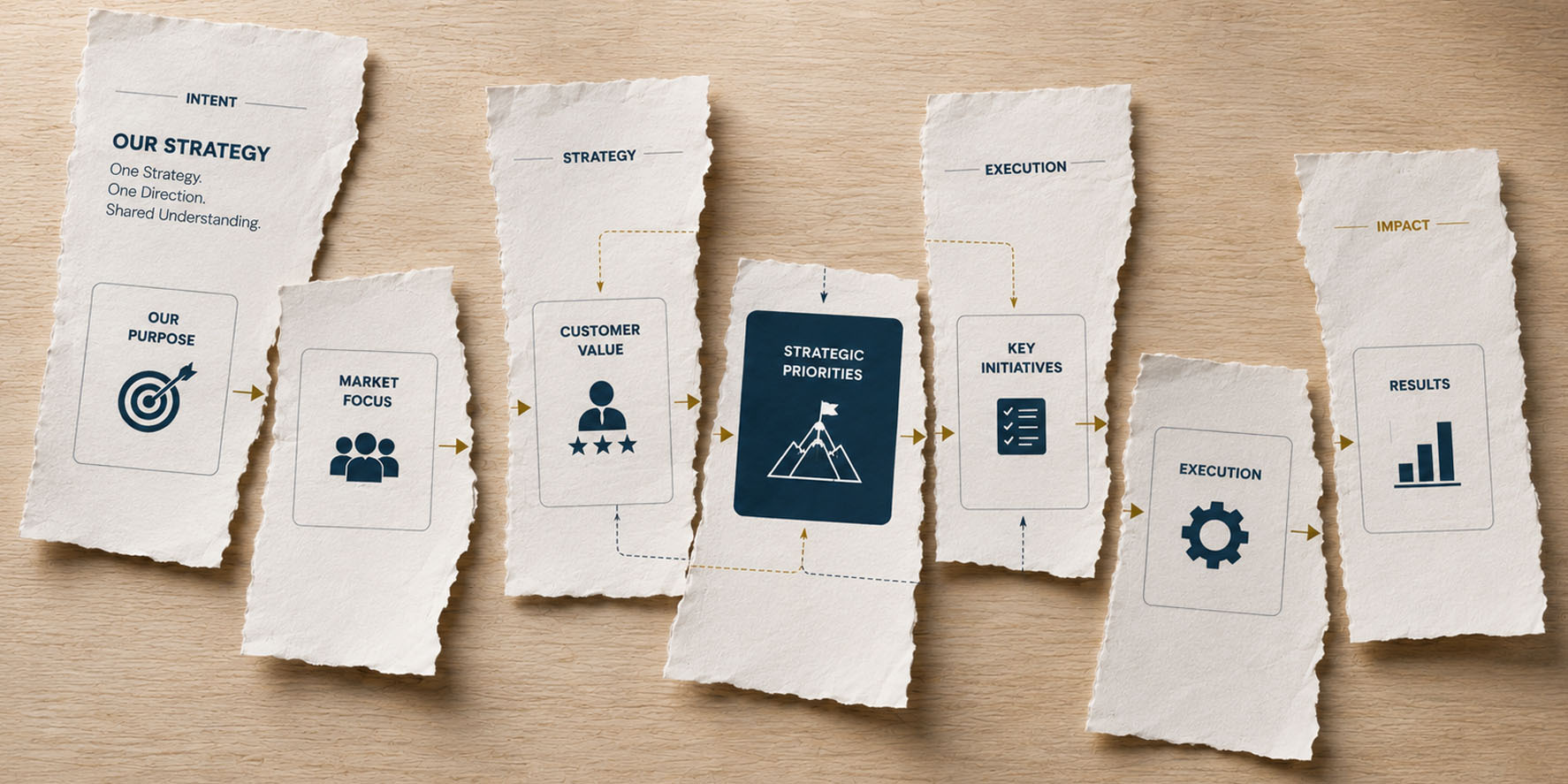
Alignment Drift™: The Risk You Don’t See Until Execution Breaks
Alignment Drift™ is the hidden gap between what leadership intends and what teams actually understand and execute. Over time, that gap creates execution drag, slows growth, and impacts performance long before it appears in financial reports.
The most expensive problems inside an organization rarely appear first in financial reports.
They appear first in execution.
Projects take longer than expected.
Decisions start getting revisited.
Teams move forward, but not from the same understanding.
By the time the impact shows up in revenue, margin, or EBITDA, the damage has already been building for months.
That problem has a name: Alignment Drift™.
What Alignment Drift™ Actually Is
Alignment Drift™ is the gradual divergence between what leadership intends and what the organization actually understands and executes.
It’s not a culture issue.
It’s not a motivation problem.
And it’s not simply a failure of communication.
It’s a gap in interpretation.
Leadership believes the strategy is clear.
Teams believe they’re executing it.
But across the organization, that strategy begins to take on slightly different meanings.
Those differences seem small at first.
But they compound.
Why It’s So Hard to See
What makes Alignment Drift™ dangerous is not that it exists — it’s that most organizations can’t see it forming.
Leadership assumes alignment.
Teams assume they’re aligned.
Execution continues.
But underneath, interpretation begins to vary.
Leadership communicates one strategy.
Departments execute against different assumptions.
No single moment looks like failure.
But the organization is no longer moving as one.
And by the time the gap becomes visible in performance, it has already been building for months.
Where It Starts to Break Down
Alignment Drift™ doesn’t come from one major mistake.
It builds through normal business activity:
• Strategy gets communicated across layers
• Departments translate priorities through their own lens
• New hires inherit the version of the strategy closest to them
• Decisions are made locally without a shared reference point
The result is predictable.
Same company.
Same strategy.
Different interpretations.
That’s where execution begins to break.
When Alignment Drift™ Accelerates: M&A and Turnover
There’s a point where Alignment Drift™ stops being gradual and starts accelerating.
It usually happens after major transitions — acquisitions, mergers, leadership turnover.
At first, the strategy is clear. The people who built it understand the market, the customer, and the problem the organization is solving. That understanding isn’t written down. It’s carried through experience, decisions, and shared context.
Then over time, those people leave.
New leadership steps in. New teams get hired. The organization continues to operate, but the underlying understanding begins to shift.
What was once direct knowledge becomes secondhand interpretation.
The market definition softens.
The customer profile evolves — not based on reality, but on internal assumptions.
The problem the organization was built to solve becomes less precise.
And no one notices it happening in real time.
The organization still has a strategy.
It still has messaging.
It still has direction.
But it is no longer operating from the same understanding that originally made it successful.
This is where Alignment Drift™ becomes structural.
In environments like private equity, where acquisitions and leadership turnover are frequent, this effect compounds quickly. Each transition introduces a new layer of interpretation — and without a way to measure alignment, that interpretation becomes the new operating reality.
By the time performance starts to break, the original clarity is already gone.
The Real Cost of Alignment Drift™
Alignment Drift™ is not a soft problem. It shows up in measurable ways across the business.
Execution slows
Teams interpret priorities differently, creating friction and execution delays.
Opportunities are missed
Initiatives lose momentum or fail to materialize as intended.
Costs increase
Rework, duplicated effort, and misallocated resources compound over time.
Teams disengage
When priorities aren’t clear, effort feels disconnected from outcomes.
Competitive advantage erodes
Organizations that move in different directions cannot compete with those that move as one.
These effects rarely get traced back to alignment.
They are treated as isolated issues — when they are all symptoms of the same root cause.
Why Most Organizations Don’t Fix It
When something feels off, most organizations respond the same way:
More meetings
More communication
More alignment sessions
But communication doesn’t solve the problem.
It transmits information.
It does not verify whether that information was understood or applied consistently.
Without measurement, alignment is assumed — not managed.
The Missing Measurement Layer
This is where most organizations fall short.
They track revenue.
They track pipeline, cost, and performance.
But they don’t track the one condition that drives all of them:
Whether the organization is actually executing the same strategy.
That’s what OAS™ (Organizational Alignment Score™) measures.
OAS™ gives leadership a clear, data-backed view of how consistently strategy is understood across the organization — and where drift is forming before it impacts results.
Instead of guessing, leadership can see alignment as a number.
And once it’s visible, it becomes manageable.
Alignment Is Not a One-Time Fix
Alignment Drift™ is not something you correct once and move past.
Organizations grow.
They hire.
They shift strategy.
They evolve.
Every one of those moments creates new opportunities for drift.
The difference between organizations that scale efficiently and those that stall is simple:
One measures alignment.
The other assumes it.
The Question Worth Asking
If execution feels slower than it should…
If priorities seem clear but results are inconsistent…
If capable teams are working hard but not producing aligned outcomes…
The question isn’t just what’s happening.
It’s whether your organization is executing the strategy you think it is.
Because until you can see alignment clearly, you can’t manage it.